
More London households are asking the same question these days: is it time to switch to eco-friendly cleaning, or does traditional cleaning still get the job done better? With growing awareness of indoor air quality, pet safety, and environmental impact, eco-friendly cleaning has moved from a niche preference to a mainstream choice for many homeowners and tenants.
At the same time, traditional cleaning products remain popular for a reason — they’re familiar, widely available, and often seen as the reliable option for tackling tough grime.
So which one is actually better for your home? The honest answer is: it depends on your household, your priorities, and the type of cleaning job at hand. This guide breaks down the real differences between eco-friendly and traditional cleaning, so you can make an informed decision — whether you’re maintaining your home day to day or preparing a property for an end of tenancy inspection.
At Urban End of Tenancy Cleaning, we work with London tenants, landlords, and homeowners every day, so we see this question come up often. Our end of tenancy cleaning London service is built to combine the best of both worlds — using eco-friendly products wherever possible, while still delivering the deep clean standard needed to pass a landlord or letting agency inspection.
What Is Eco-Friendly Cleaning?
Eco-friendly cleaning refers to cleaning methods that rely on plant-based, biodegradable, or otherwise environmentally conscious products instead of conventional chemical-heavy formulas. These products are typically designed to minimise environmental impact while still removing dirt, grease, and grime from household surfaces.
In practice, eco-friendly cleaning in London often means:
- Using plant-based or naturally derived cleaning agents
- Choosing products with reduced or no harsh synthetic fragrances
- Selecting biodegradable formulas that break down more easily after use
- Reducing packaging waste through refillable or concentrated products
The main appeal of eco-friendly cleaning services in London is that they aim to lower chemical exposure indoors while still delivering a genuinely clean result — not simply swapping effectiveness for “green” branding.
What Is Traditional Cleaning?
Traditional cleaning typically involves conventional, chemical-based products that have been the industry standard for decades. These products are formulated for strong cleaning power and are widely trusted for cutting through grease, limescale, and stubborn buildup quickly.
Traditional cleaning products often include:
- Strong degreasers for kitchens and ovens
- Bleach-based disinfectants
- Heavy-duty limescale and mould removers
- Solvent-based polishes and stain removers
Many professional cleaning services in London still rely on select traditional products for specific deep cleaning services, simply because certain chemical formulas are extremely effective at tackling particular problems — especially in high-grime environments.
Eco-Friendly Cleaning vs Traditional Cleaning: Key Differences
Here’s a side-by-side look at how the two approaches compare:
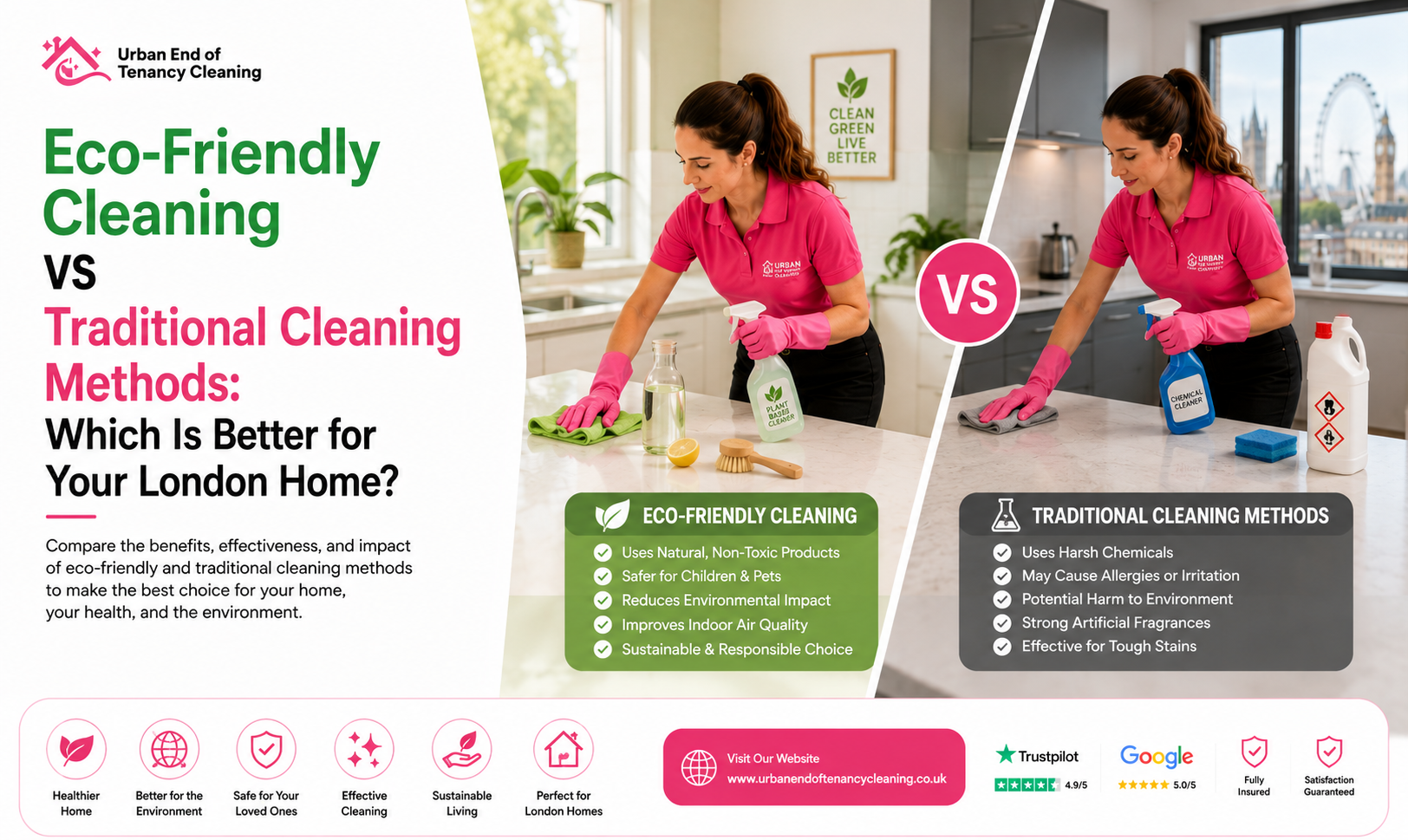
| Factor | Eco-Friendly Cleaning | Traditional Cleaning |
| Cleaning products | Plant-based/natural options | Conventional chemical products |
| Indoor air quality | Generally lower chemical exposure | May leave stronger chemical smells |
| Environment | Lower environmental impact | Some products may create more waste |
| Pets | Often suitable when properly selected | Depends on the chemicals used |
| Allergies | Can be preferable for sensitive households | Some products may trigger sensitivities |
| Cleaning performance | Effective with the right products and methods | Strong performance depending on product |
Neither approach is universally “better” — the right choice depends on the property, the household, and the specific cleaning task involved.
Is Eco-Friendly Cleaning Safer for Allergy Sufferers?
Many people with sensitivities to strong fragrances or airborne chemical residue find that eco-friendly cleaning products feel gentler to be around. Traditional cleaning products can sometimes leave a lingering chemical smell, which some household members find irritating, particularly in smaller or poorly ventilated spaces.
That said, product selection matters more than the “eco” label alone. Not every natural product is automatically low-allergen — some plant-based ingredients can still trigger sensitivities in certain individuals. It’s also worth noting that dust and allergens themselves are a major factor in allergy discomfort, so thorough deep cleaning (removing dust, pet dander, and debris) plays just as important a role as the products used.
We’re not making medical claims here — if you have specific allergy concerns, it’s worth speaking with a healthcare professional. But for many households, choosing lower-fragrance, non-toxic cleaning products is a reasonable step toward a more comfortable home environment.
Is Eco-Friendly Cleaning Better for Homes With Pets?
Pet owners are often among the first to consider switching to eco-friendly cleaning services, and it’s easy to see why. Pets spend a lot of time close to floors and surfaces, so residue from cleaning products is a real consideration.
A few things worth knowing:
- Gentler, plant-based products are often preferred in pet-friendly cleaning services because they reduce the risk of residue-related irritation.
- “Natural” doesn’t automatically mean pet-safe — some essential oils and plant-derived ingredients can actually be harmful to cats and dogs, so ingredient selection still matters.
- Pets should always be kept away from freshly cleaned areas until surfaces are fully dry, regardless of which products are used.
- Professional cleaners who understand pet-friendly cleaning will select products with pets specifically in mind, rather than assuming eco-friendly automatically equals pet-safe.
If you have pets, it’s worth asking any cleaning company directly about their product choices rather than assuming.
Can Eco-Friendly Cleaning Handle Deep Cleaning?
One common misconception is that eco-friendly cleaning is somehow “weaker” than traditional cleaning. In reality, effectiveness comes down to product quality, technique, and equipment — not just whether a product is labelled eco-friendly.
Eco-friendly deep cleaning can cover the same ground as traditional deep cleaning, including:
- Kitchen cleaning — degreasing hobs, ovens, and worktops
- Bathroom cleaning — tackling limescale, soap scum, and grout
- Floors and surfaces — deep-cleaning hard floors and carpets
- High-touch areas — door handles, switches, and other frequently touched surfaces
- Move-out cleaning — full end of tenancy cleans ready for inspection
The key is using the right eco-friendly product for the right job, paired with proper technique — which is exactly where professional eco cleaners in London add value over a generic DIY approach.
Eco-Friendly Cleaning for End of Tenancy Properties
End of tenancy cleaning is one area where eco-friendly cleaning has become especially relevant, since these cleans need to be thorough enough to satisfy landlord and inspection standards while remaining considerate of the next occupants and the environment.
A well-executed eco-friendly end of tenancy clean typically covers:
- Removing built-up dirt and grime throughout the property
- Deep cleaning kitchen appliances, including ovens, fridges, and extractor fans
- Thorough bathroom cleaning, including tiles, grout, and fixtures
- Cleaning floors and carpets to remove marks and residue
- Preparing the property so it’s ready to pass a landlord or agency inspection
- Using environmentally conscious products where they can deliver the required standard
Because end of tenancy cleaning is judged against strict checklists, the products used need to perform reliably — which is why many professional cleaning services combine eco-friendly options with targeted traditional products only where genuinely necessary.
This is exactly the approach we take at Urban End of Tenancy Cleaning. Our end of tenancy cleaning London service is designed around checklist-standard results, using eco-friendly products as the default choice and switching to a targeted traditional product only where a specific area genuinely needs it — so you get a property that’s both spotless and ready for inspection.
Benefits of Choosing Professional Eco Cleaners in London
Hiring a professional eco-friendly cleaning service, rather than attempting an eco clean yourself, comes with a few practical advantages:
- Professional equipment designed to work effectively with eco-friendly formulas
- Informed product selection, matching the right product to the right surface or task
- Consistent standards, so results don’t vary clean to clean
- Less guesswork, since professionals already know what works and what doesn’t
- Flexibility across property types, from small flats to larger family homes
This is particularly useful for busy households, landlords managing multiple properties, or tenants who need a guaranteed standard of clean before moving out.
When Traditional Cleaning May Still Be Preferred
A balanced view means acknowledging that traditional cleaning still has its place. There are situations where stronger, conventional products may genuinely be the better tool for the job:
- Heavy grease buildup that has accumulated over a long period
- Specialised cleaning requirements, such as certain industrial-grade stains
- Situations where a stronger disinfectant is specifically required
- Cases where a particular problem simply hasn’t responded well to gentler products
Good professional cleaners don’t take a rigid “all eco” or “all traditional” approach — they select products based on what the specific cleaning task actually requires.
How to Choose an Eco-Friendly Cleaning Company in London
If you’re comparing cleaning companies, here’s a practical checklist to work through:
- Ask which specific products they use, not just whether they call themselves “eco-friendly”
- Check whether those products are genuinely environmentally friendly, not just marketed that way
- Ask directly about pet-friendly product options if you have animals at home
- Check their experience with the type of cleaning you need (deep clean, end of tenancy, regular clean)
- Look for transparent information about their process and pricing
- Read genuine customer reviews rather than relying on marketing claims alone
- Confirm they offer the exact service you’re looking for, whether that’s a one-off deep clean or a full end of tenancy clean
Why Choose Urban End of Tenancy Cleaning
If you’re in London and preparing for a move, Urban End of Tenancy Cleaning offers professional end of tenancy cleaning that’s built to meet inspection standards while staying mindful of the environment, your pets, and anyone in the household with allergy sensitivities. Our team knows exactly when an eco-friendly product will do the job and when a targeted traditional product is genuinely needed — so nothing is left to guesswork.
Whether you need a full end of tenancy clean, a one-off deep clean, or general eco-friendly cleaning services in London, our team is ready to help you get the property inspection-ready without the stress.
Eco-Friendly vs Traditional Cleaning: Which One Should You Choose?
Choose eco-friendly cleaning if:
- You prefer environmentally conscious products
- You have pets in the home
- You want to reduce exposure to strong cleaning chemicals
- You prefer lower-fragrance cleaning options
Choose traditional cleaning if:
- You need a specific heavy-duty cleaning treatment
- A particular cleaning problem requires a specialised product
For many London households, the most practical answer isn’t choosing one exclusively — it’s working with a professional cleaning service that uses eco-friendly products as standard, while still having access to targeted traditional solutions when a specific task genuinely calls for it.
Ready to book a clean that gets this balance right? Get in touch with Urban End of Tenancy Cleaning for eco-friendly end of tenancy cleaning across London.
Frequently Asked Questions
1. What is eco-friendly cleaning?
Eco-friendly cleaning uses plant-based, biodegradable, or otherwise environmentally conscious products instead of conventional chemical-heavy formulas, aiming to reduce environmental impact and indoor chemical exposure.
2. Is eco-friendly cleaning effective for deep cleaning?
Yes. Effectiveness depends on the quality of the products and the technique used, not simply whether a product is labelled eco-friendly. With the right approach, eco-friendly deep cleaning can achieve results comparable to traditional methods.
3 Are eco-friendly cleaning products safe for pets?
Many are, but not automatically. “Natural” doesn’t always mean pet-safe, since some plant-derived ingredients can still be harmful to animals. It’s best to ask a cleaning company specifically about pet-safe product selection.
4. Is eco-friendly cleaning better for allergy sufferers?
Many people with sensitivities to strong fragrances find eco-friendly, lower-fragrance products more comfortable. However, individual sensitivities vary, and this isn’t a medical guarantee — it’s worth discussing specific allergy concerns with a healthcare professional.
5. How much does eco-friendly cleaning cost in London?
Pricing varies depending on the size of the property, the type of clean required (regular, deep, or end of tenancy), and the specific company. It’s best to request a quote based on your property’s needs.
6. Can I get eco-friendly end of tenancy cleaning in London?
Yes. Many professional cleaning companies in London now offer eco-friendly options for end of tenancy cleans, covering kitchens, bathrooms, floors, and other inspection-critical areas.
7. Are eco-friendly cleaning products chemical-free?
Not technically — water itself is a chemical, so no cleaning product is truly “chemical-free.” Eco-friendly products are more accurately described as low-chemical, non-toxic, or plant-based, using naturally derived ingredients rather than being free of chemicals altogether.