
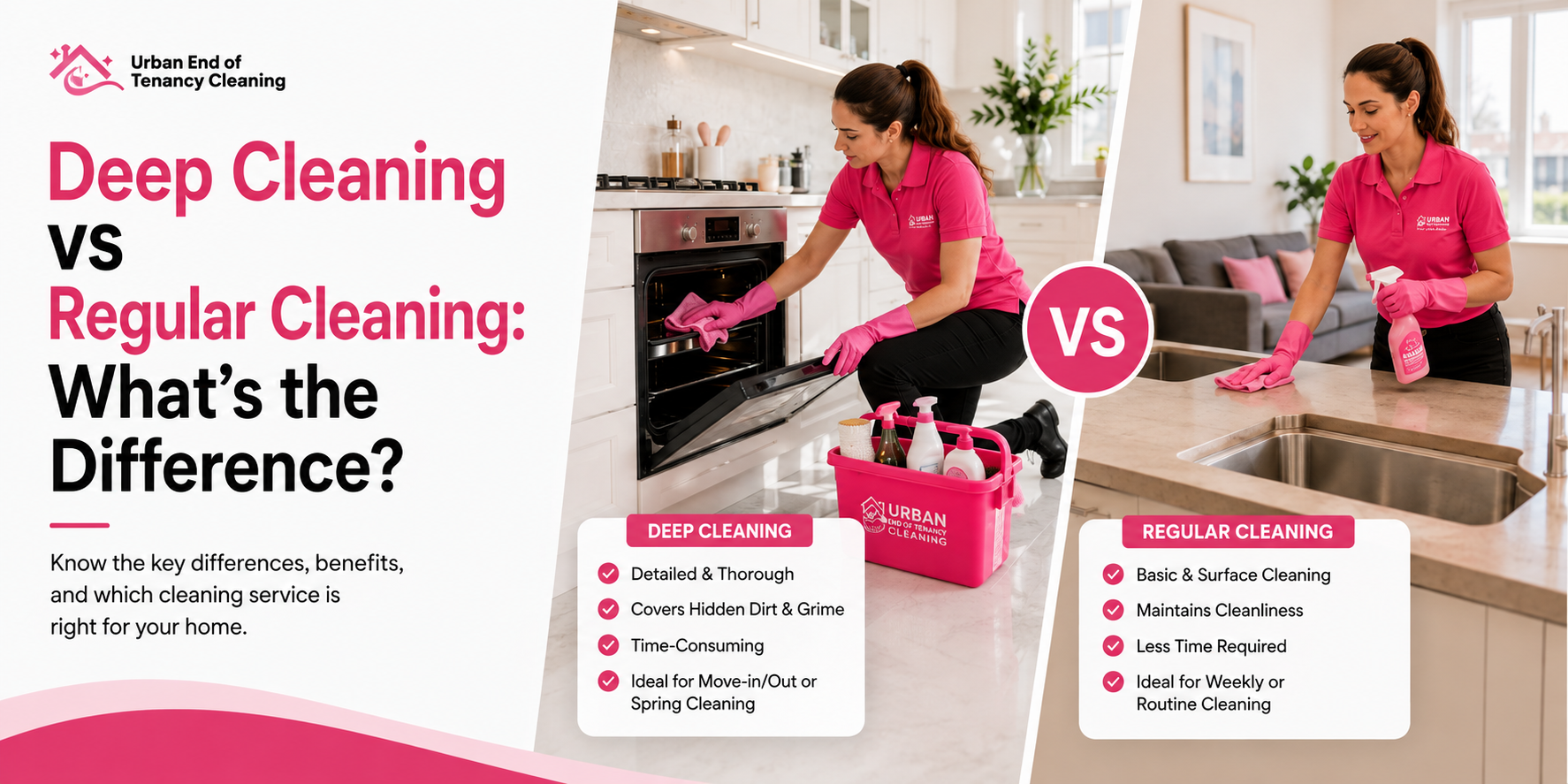
If you’ve ever searched for end of tenancy cleaning or regular house cleaning, you’ve probably noticed the terms get used almost interchangeably online — but they’re not the same service at all. Both involve cleaning a home, yet they exist for very different reasons.
Regular house cleaning is about maintaining a home you’re currently living in — keeping it tidy, hygienic and comfortable on an ongoing basis. End of tenancy cleaning, on the other hand, is a one-off, top-to-bottom clean designed to prepare a rental property for handover, ready for the final inspection and the next occupant.
Understanding the difference between end of tenancy cleaning and regular cleaning matters more than it might seem — get it wrong, and you could end up short-changed on your deposit, or paying for a service that’s more (or less) than you actually need. This guide breaks down exactly what each service includes, how they compare, and how to decide which one is right for your situation.
What Is Regular House Cleaning?
Regular house cleaning is routine maintenance cleaning, usually carried out weekly, fortnightly or monthly while you’re living in the property. It’s designed to keep a home looking and feeling clean day-to-day, rather than to meet the standards of a landlord inspection.
What Does Regular House Cleaning Usually Include?
- Dusting surfaces
- Vacuuming carpets and floors
- Mopping hard floors
- Cleaning bathrooms (toilet, sink, shower/bath surfaces)
- Wiping down kitchen surfaces
- Emptying bins
- Basic tidying of bedrooms and living areas
A regular house cleaning service focuses on visible, everyday dirt rather than the deep-set grime that builds up over months or years — things like the inside of your oven or behind the fridge typically aren’t part of a standard visit.
What Is the End of Tenancy Cleaning?
End of tenancy cleaning is a far more detailed, intensive clean carried out when a tenant is moving out of a rented property. The goal isn’t just cleanliness — it’s meeting the standard set out in the original inventory report, so the property can be handed back without disputes over its condition.
This typically includes:
- Kitchen appliances (inside and out)
- Inside cupboards and drawers
- Full oven cleaning
- Bathroom descaling
- Skirting boards
- Doors and door handles
- Windows (internal)
- Floors and carpets
- Hard-to-reach areas often missed during routine cleaning
Current UK end-of-tenancy guidance consistently flags ovens, extractor fans, cupboard interiors, limescale build-up and skirting boards as the areas most commonly checked during a final inspection — which is exactly why professional end of tenancy cleaning puts so much focus on them.
End of Tenancy Cleaning vs Regular House Cleaning: Side-by-Side Comparison
| Feature | Regular House Cleaning | End of Tenancy Cleaning |
| Purpose | Ongoing maintenance | Preparing property for handover |
| Frequency | Weekly / fortnightly / monthly | Usually a single, one-off clean |
| Cleaning level | Basic / general | Detailed / deep |
| Oven | Usually exterior only | Full interior and exterior clean |
| Inside cupboards | Usually not included | Often included |
| Skirting boards | Light dusting | Detailed cleaning |
| Appliances | Surface wipe-down | Inside and outside where included |
| Inspection preparation | No | Yes |
| Deposit concerns | Not relevant | Often directly relevant |
This table sums up the core end of tenancy vs regular cleaning decision: one is about upkeep, the other is about proof of condition.
What Does End of Tenancy Cleaning Include That Regular Cleaning Doesn’t?
Kitchen Deep Cleaning
- Oven (interior, racks, glass)
- Hob and rings
- Extractor fan and filter
- Inside all cupboards and drawers
- Fridge and freezer (interior)
- Splashbacks and tiles
- Sink, taps and drainage
Bathroom Deep Cleaning
- Toilet (including base and cistern)
- Shower and bath
- Tiles and grout
- Limescale removal
- Mirrors
- Taps and fixtures
Bedrooms and Living Areas
- Skirting boards
- Doors and frames
- Handles and light switches
- Floors, including under furniture where accessible
- Dust in corners and edges
- Interior of built-in cupboards and wardrobes
Windows and Other Details
- Internal windows and glass
- Window frames and sills
- High or hard-to-reach surfaces
- Areas typically missed during routine cleaning, such as behind appliances
Why Is the End of Tenancy Cleaning More Thorough?
It’s not just a case of “cleaning harder” — end of tenancy cleaning is thorough because of what it’s actually for:
- Property handover — the property needs to be returned in a condition that matches (or is close to) how it was let
- Landlord and letting-agent expectations — many agencies work from a professional-standard checklist during check-out
- Final inspection — the property is formally assessed against the original inventory
- Removing accumulated dirt — build-up that regular cleaning simply doesn’t reach over months of tenancy
- Covering areas missed during routine cleaning — ovens, cupboard interiors, skirting boards
- Preparing for the next occupant — the property needs to be ready to let again
A recent 2026 UK survey found that around a quarter of renters had experienced a dispute with a landlord over cleanliness at the end of a tenancy, with oven condition, bathroom limescale and windows coming up as some of the most common sticking points. It’s a useful reminder that “clean” and “end-of-tenancy clean” aren’t always the same thing in a landlord’s eyes.
Can Regular House Cleaning Be Enough Before Moving Out?
Usually, no — not if the property needs a genuine move-out standard clean.
If a home has been exceptionally well maintained throughout the tenancy, less additional work might be needed. But in most cases, regular cleaning simply doesn’t cover the areas landlords and agents check most closely: inside appliances, cupboard interiors, detailed bathroom descaling, skirting boards and other move-out-specific tasks.
Before deciding, it’s worth checking your tenancy agreement and the original inventory report, as these usually set out the standard you’re expected to return the property to.
End of Tenancy Cleaning Checklist
Kitchen
- Oven
- Hob
- Extractor fan
- Cupboards (inside and out)
- Fridge/freezer
- Worktops
- Sink
- Floor
Bathroom
- Toilet
- Shower/bath
- Tiles
- Grout
- Limescale
- Mirrors
- Floor
Other Rooms
- Skirting boards
- Doors
- Handles
- Windows
- Floors
- Cupboards
- Dust and cobwebs
Use this end of tenancy cleaning checklist as a starting point before your check-out inspection — it covers the areas most commonly flagged during move-out assessments.
When Should You Choose Regular House Cleaning?
- You currently live in the property
- You need ongoing weekly or fortnightly maintenance
- You want to keep on top of everyday dust and dirt
- You’re not moving out any time soon
- You want reliable, ongoing cleaning support
When Should You Choose the End of Tenancy Cleaning?
- You’re moving out of a rented property
- You’re preparing for a final inspection
- You’re handing keys back to a landlord or agent
- You’re moving between rental properties
- You’re preparing a property for new tenants
- The property needs a detailed, deep clean rather than routine upkeep
DIY vs Professional End of Tenancy Cleaning
DIY
- Lower direct cost
- Requires significant time
- Requires your own cleaning products and equipment
- Easy to miss detailed, inspection-critical areas
Professional
- Saves time during an already busy move
- Follows a structured, comprehensive checklist
- Better suited to larger properties or heavier build-up
- Helps tackle difficult areas like ovens, extractor fans and grout
It’s worth being clear-eyed here: professional cleaning improves your chances of a smooth handover, but it can’t guarantee your full deposit back. That ultimately depends on the property’s overall condition, the original inventory, and the terms of your tenancy agreement.
How Much Does the End of Tenancy Cleaning Cost?
Pricing for end of tenancy cleaning varies depending on several factors:
- Size of the property
- Number of bedrooms
- Current condition of the property
- Specific cleaning requirements
- Any additional services (e.g. carpet cleaning, external windows)
- Location, including areas across London
For an accurate quote based on your property, get in touch with Urban End of Tenancy Cleaning directly.
End of Tenancy Cleaning in London
For tenants and landlords across London, end of tenancy cleaning often needs to fit around tight moving schedules and strict letting-agent standards. A professional end of tenancy cleaning service in London can help ensure the property meets the expectations set out in the inventory report, without adding extra stress to moving days.
FAQs
1. Is end of tenancy cleaning the same as a deep clean?
They’re closely related. End of tenancy cleaning is essentially a deep clean, but tailored specifically to the areas landlords and agents check during a move-out inspection, such as ovens, cupboards and skirting boards.
2. What is the difference between regular cleaning and end of tenancy cleaning?
Regular cleaning maintains a home you’re living in, focusing on everyday surfaces. End of tenancy cleaning is a one-off, detailed clean carried out when moving out, covering areas like appliance interiors and hard-to-reach spots that routine cleaning doesn’t touch.
3. Does end of tenancy cleaning include the oven?
Yes, a full interior and exterior oven clean is a standard part of most end of tenancy cleaning services, since ovens are one of the most commonly checked items during inspections.
4. Do I need professional end of tenancy cleaning?
It depends on the property’s condition and your available time. Professional cleaning can help cover detailed, inspection-critical areas that are easy to miss with a DIY approach.
5. What should I clean before moving out?
Focus on the kitchen (oven, hob, cupboards, fridge), the bathroom (limescale, grout, tiles), skirting boards, doors, windows and any areas that weren’t part of your regular cleaning routine.
6. Does regular cleaning include inside cupboards?
Usually not. Regular cleaning tends to focus on visible, everyday surfaces rather than cupboard interiors, which are typically covered under end of tenancy cleaning.
7. How long does the end of tenancy cleaning take?
This varies by property size and condition, but it generally takes longer than a routine clean because of the level of detail involved, particularly in the kitchen and bathroom.
8. Can I do the end of tenancy cleaning myself?
Yes, though it requires time, the right products, and close attention to detail to match the standard expected at inspection. Many tenants choose a professional service to reduce the risk of missing something.
9. What do landlords check during a final inspection?
Landlords and agents typically check the property against the original inventory report, paying close attention to the kitchen, bathroom, appliances, skirting boards, windows and overall cleanliness compared to move-in condition.